





Are You in the UK Top 1%? Income Threshold, Salary and Wealth Explained
Many people wonder what it takes to become one of the UK's highest earners.
A salary of £50,000 can represent a strong income for many people. Earning £100,000 places an individual well above the typical UK income level. But how much do you actually need to earn to be considered part of the UK's top 1%?
The answer is higher than many people expect.
According to the latest HM Revenue & Customs Personal Incomes Statistics currently available, the 99th-percentile income was approximately £207,000 in the 2023–24 tax year. This means an individual with income around or above that level was around the top 1% of the relevant taxpayer income distribution.
However, there is an important distinction that is often missed when discussing the UK's richest or highest earners:
Income is not the same as wealth.
Someone can have a very high annual income without having a large net worth, while someone with substantial accumulated wealth may have a relatively modest annual income.
In this guide, we will look at:
• The current UK top 1% income threshold
• Whether £100,000 is top 1%
• Whether £150,000 is top 1%
• Whether £200,000 is top 1%
• What £250,000 means in the UK income distribution
• Individual income versus household income
• Salary versus total income
• London and regional income differences
• Careers associated with very high incomes
• Top 1% versus top 0.1%
• Income versus wealth
• How high earners can build long-term wealth
• What high income can mean for lifestyle and dating
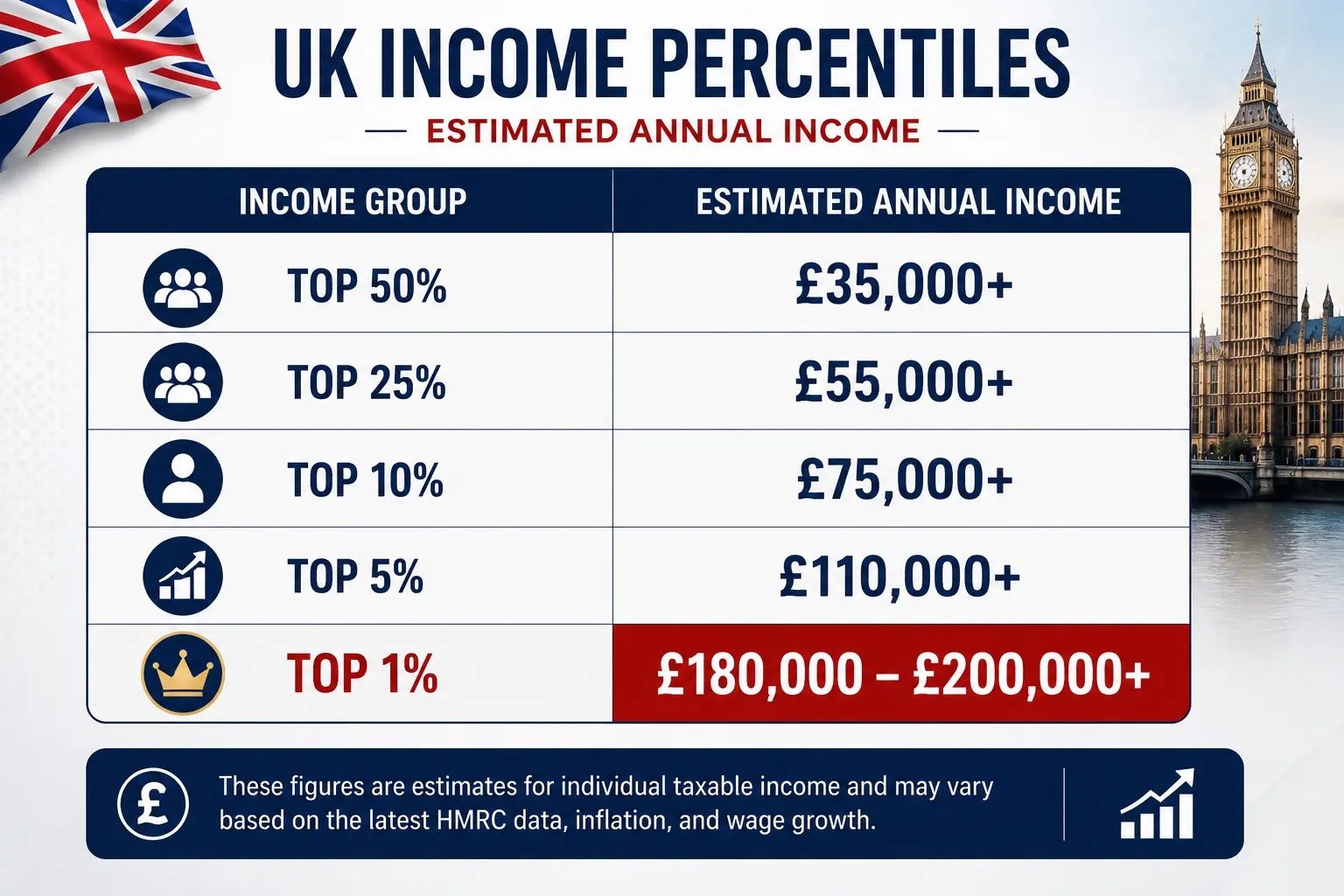
What Does “Top 1%” Mean in the UK?
When people say someone is in the “top 1%,” they are generally referring to someone whose income or wealth is higher than approximately 99% of the relevant population.
But you need to know exactly what is being measured.
A top-1% statistic might refer to:
• Individual income
• Household income
• Taxable income
• Total income
• Net wealth
• Adults
• Taxpayers
These measurements can produce very different results.
For this article, the focus is primarily on individual income.
HMRC's Personal Incomes Statistics provide data on individual income and percentile thresholds. For the 2023–24 tax year, HMRC reported the 99th-percentile income at approximately £207,000.
Therefore, when discussing the UK's top 1%, it is important not to mix an individual-income threshold with a household-income figure.
What Annual Income Puts You in the UK's Top 1%?
The latest HMRC Personal Incomes Statistics provide an important benchmark.
For the 2023–24 tax year, approximately £207,000 of total income before tax represented the 99th percentile.
This makes £207,000 a useful reference point when asking:
“How much do I need to earn to be in the UK top 1%?”
However, the figure should not be treated as a permanent threshold.
Income distributions change every year.
A threshold from an older article may therefore be considerably different from the latest available figure.
This is one reason it is important to include the relevant tax year whenever discussing income percentiles.
How Has the UK Top 1% Income Threshold Changed?
The income required to reach the top 1% has increased over time.
HMRC data shows that the 99th-percentile income increased from approximately £159,000 in 2013–14 to £207,000 in 2023–24.
That illustrates why old articles can give very different answers to the same question.
If you search online for:
“UK top 1% salary”
you may find figures ranging from approximately £150,000 to more than £200,000.
The difference does not necessarily mean one source is wrong.
The sources may be referring to different:
• Years
• Populations
• Income definitions
• Statistical methodologies
Always check the date and definition before comparing numbers.
Is £100,000 a High Salary in the UK?
Yes.
But £100,000 is not the latest UK top-1% income threshold.
The latest HMRC 99th-percentile benchmark is approximately £207,000 for 2023–24.
So someone earning £100,000 has a high individual income but is below the latest published top-1% benchmark.
There is another important consideration at this income level.
Under the UK's current income-tax system, the Personal Allowance begins to taper once adjusted net income exceeds £100,000 and is fully withdrawn at £125,140.
This means the financial impact of earning more than £100,000 can be significant even though the income remains below the top-1% percentile threshold.
Is £150,000 in the UK Top 1%?
£150,000 is a very high individual income.
However, it remains below the latest HMRC 99th-percentile benchmark of approximately £207,000 for 2023–24.
Therefore, it would be more accurate to describe £150,000 as a very high UK income rather than automatically calling it a top-1% income.
This distinction is important because tax thresholds and income percentiles are different measurements.
Someone can be subject to higher or additional rates of income tax without necessarily being at the 99th percentile.
Is £200,000 a Top 1% Income in the UK?
£200,000 is extremely close to the latest published UK top-1% benchmark.
HMRC reported approximately £207,000 at the 99th percentile for 2023–24.
So an income of £200,000 is best described as around the current top-1% level, rather than saying that exactly £200,000 automatically represents the top 1% in every context.
The precise percentile can depend on the definition and tax year being used.
Is £250,000 a Top 1% Income in the UK?
An individual income of £250,000 is above the latest published 99th-percentile benchmark of £207,000 for 2023–24.
Therefore, £250,000 is above the published top-1% threshold for that tax year.
However, being above the top-1% threshold does not tell you exactly where someone sits within the remaining top 1%.
The difference between someone earning £210,000 and someone earning £1 million can be enormous, even though both are technically above the 99th percentile.
£100k vs £150k vs £200k vs £250k
These income levels can provide a useful way to understand the UK income distribution.
£100,000
A high individual income, but below the latest published top-1% benchmark.
£150,000
A very high individual income, but still below the latest £207,000 99th-percentile benchmark.
£200,000
Very close to the latest published top-1% level.
£250,000
Above the latest published 99th-percentile benchmark.
These are reference points rather than permanent classifications because income distributions change over time.
Salary Is Not the Same as Total Income
Another important issue is the difference between salary and total income.
Someone may receive income from:
• Employment
• Bonuses
• Self-employment
• Business activities
• Dividends
• Property
• Interest
• Other taxable sources
Therefore, someone with a £150,000 salary may have substantially more total income once other sources are included.
Conversely, someone may have a large salary but relatively little additional taxable income.
When comparing yourself with a published top-1% figure, make sure you know whether the statistic refers to:
Salary
or
Total income
or
Taxable income
The distinction can materially change the comparison.
Individual Income vs Household Income
This is one of the biggest sources of confusion in international income comparisons.
Imagine a household where:
Person A earns £120,000.
Person B earns £90,000.
Together, they have household income of £210,000.
But neither individual earns £210,000.
The UK top-1% statistic discussed here is an individual-income measure, not a simple household-income measure.
This means an article comparing UK individual income with a US household-income chart could produce a misleading result unless the methodology is clearly explained.
If you are comparing countries, always ask:
Is this individual income or household income?
London vs the Rest of the UK
Where someone lives can have a major impact on their lifestyle even when their income is identical.
London has a particularly large concentration of high-paying industries and senior professional roles.
Examples include:
• Investment banking
• Private equity
• Asset management
• Corporate law
• Technology
• Consulting
• Executive management
• Entrepreneurship
• Specialist medicine
The City of London and Canary Wharf are particularly associated with high-paying financial and professional careers.
However, high income should always be considered alongside living costs.
Housing, transportation, education, childcare, dining and other expenses can be significantly higher in London than in many other parts of the UK.
Does Living in London Mean You Are in the Top 1%?
No.
Living in London does not automatically determine your income percentile.
A person can live in London and earn substantially below the top-1% threshold.
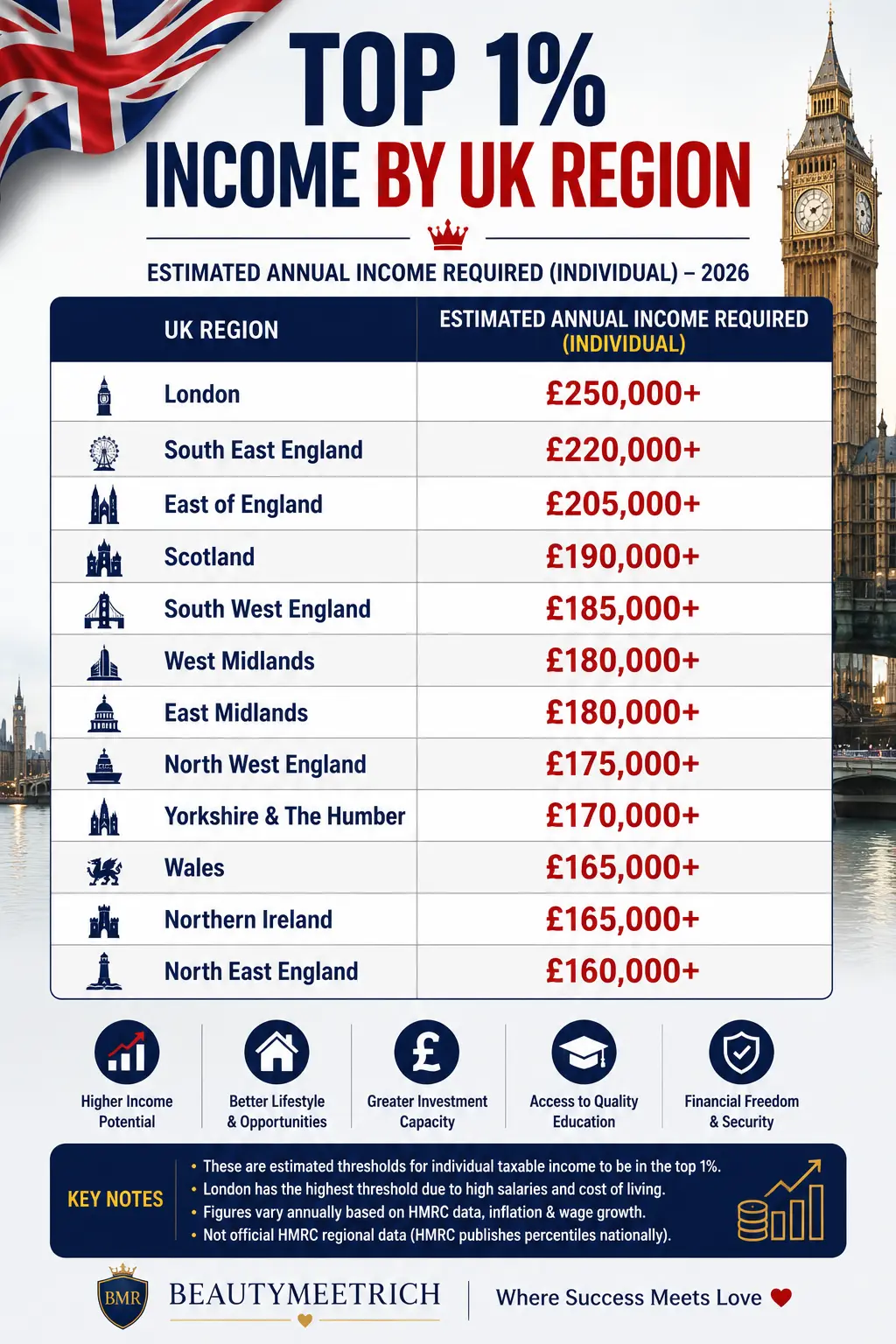
Likewise, someone living in Manchester, Birmingham, Edinburgh, Bristol, Leeds or another UK city can earn enough to be among the highest individual earners.
Location affects the cost of living and the concentration of high-paying jobs, but it does not by itself determine income rank.
Which Careers Produce High Incomes in the UK?
There is no career that guarantees a top-1% income.
However, very high individual incomes can occur in several professions and industries.
Investment Banking
Senior investment banking professionals can receive substantial compensation through salary and bonuses.
Private Equity
Senior private-equity professionals can receive compensation from salaries, bonuses and investment-related arrangements.
Corporate Law
Senior lawyers and partners at successful firms can achieve very high incomes.
Technology
Senior technology executives, founders and highly specialized professionals can earn substantial compensation, particularly where equity is involved.
Medicine
Certain highly experienced medical specialists can earn high professional incomes.
Entrepreneurship
Business ownership can produce significant financial upside, although entrepreneurial income is not guaranteed and businesses can also fail.
Executive Management
CEOs and other senior executives can receive salaries, bonuses, shares and other forms of compensation.
Finance and Investment
Senior professionals in investment management and related financial sectors can earn substantial incomes.
At the highest levels, compensation often extends beyond basic salary.
Bonuses, equity, partnership distributions, business profits and investments can all influence total income.
Top 1% vs Top 0.1%
The top 1% should not be treated as one homogeneous group.
There can be a huge difference between:
Someone just above the 99th percentile
and
Someone in the top 0.1%.
Historical research from the Institute for Fiscal Studies illustrates this difference. Its analysis found that around £160,000 was required to enter the top 1% at the time, while approximately £650,000 was required to enter the top 0.1%. Those figures are historical and should not be treated as current thresholds, but they demonstrate the large gap within the highest-income groups.
The broader lesson is important:
Being in the top 1% does not mean everyone in that group has the same income or lifestyle.
Income Is Not the Same as Wealth
This distinction is essential.
Income
Income is money received during a specific period.
For example:
£200,000 per year.
Wealth
Wealth refers broadly to accumulated assets minus liabilities.
It can include:
• Property
• Shares
• Businesses
• Pension assets
• Cash savings
• Investments
minus debts such as:
• Mortgages
• Loans
• Other liabilities
A high income can help someone build wealth, but it does not automatically create wealth.
Can Someone Earning £250,000 Have Less Wealth Than Someone Earning £80,000?
Yes.
Consider two hypothetical people.
Person A earns £250,000 per year but has:
• A large mortgage
• High household expenses
• Significant debt
• Expensive lifestyle commitments
• Limited investments
Person B earns £80,000 but has:
• Several years of savings
• A valuable investment portfolio
• Property with substantial equity
• A successful business
• Low debt
Person B could have a higher net worth despite earning considerably less every year.
This is why income and wealth should always be discussed separately.
Does a Top 1% Income Make You a Millionaire?
No.
A millionaire is generally someone whose net worth reaches at least £1 million under the definition being used.
A top-1% income is an annual income measurement.
The two concepts are completely different.
Someone can earn £250,000 and not have £1 million in net assets.
Another person could have £2 million in assets but earn much less in a particular year.
Does a Top 1% Income Mean Financial Independence?
Not automatically.
Financial independence depends on more than income.
It can depend on:
• Net worth
• Spending
• Debt
• Housing costs
• Investment returns
• Family responsibilities
• Retirement needs
• Lifestyle expectations
A high income can make building financial independence easier, but spending patterns and asset ownership matter too.
How Do High Earners Build Long-Term Wealth?
High income creates an opportunity to accumulate assets.
It does not guarantee that outcome.
People building long-term wealth may use strategies such as:
Investing
Investing can allow surplus income to be converted into financial assets over time.
Different people use different combinations of diversified funds, shares, property and other assets depending on their circumstances and risk tolerance.
Business Ownership
A successful business can provide income and potentially become a valuable asset.
Property
Property can form part of a long-term wealth strategy, although it also involves maintenance, financing, taxes, vacancies and market risk.
Pension Contributions
Pensions can play an important role in long-term retirement planning.
Controlling Lifestyle Inflation
A major challenge of increasing income is allowing spending to rise at the same rate.
If someone increases their income substantially but spends almost all of the additional money, the increase in income may produce less wealth than expected.
Why Lifestyle Inflation Matters
Suppose someone increases their annual income from £80,000 to £200,000.
They might respond by buying:
• A significantly more expensive home
• A luxury car
• More expensive holidays
• More expensive dining
• Additional subscriptions
• Expensive hobbies
If spending rises almost as quickly as income, the person's wealth may not increase as dramatically as their salary suggests.
High income becomes more powerful when some of the additional income is converted into assets and long-term savings.
How Can Someone Work Toward a Very High Income?
There is no guaranteed formula for reaching the top 1%.
However, common approaches include:
Develop High-Value Skills
Specialized technical, financial, legal, medical and managerial skills can command higher compensation.
Build Expertise
Deep expertise can make you more valuable in competitive industries.
Seek Greater Responsibility
Leadership positions often come with higher compensation.
Consider Business Ownership
Ownership can provide financial upside that a fixed salary may not provide, although it also involves greater risk.
Build Professional Relationships
Professional networks can create opportunities for employment, partnerships and business growth.
Continue Learning
Industries change continuously.
Skills that are highly valuable today may not remain equally valuable in the future.
The Role of Bonuses and Equity
For many very high earners, base salary tells only part of the story.
Compensation can include:
• Annual bonuses
• Stock
• Stock options
• Partnership distributions
• Profit sharing
• Business ownership
• Investment income
This is particularly relevant in finance, technology, executive positions and entrepreneurship.
Someone with a moderate base salary can potentially have a much higher total income in a year with substantial bonuses or investment gains.
Why the Top 1% Figure Changes
The top-1% threshold is not a fixed number.
It can change because of:
• Wage growth
• Inflation
• Bonuses
• Business income
• Investment income
• Labour-market conditions
• Changes in the income distribution
HMRC's historical data demonstrates this movement, with the 99th-percentile income increasing from approximately £159,000 in 2013–14 to £207,000 in 2023–24.
Therefore, an article published several years ago may contain a threshold that was accurate at the time but is no longer current.
Why High Income Can Influence Lifestyle Compatibility
Income is not the only factor that matters in relationships, but significant differences in income can sometimes create lifestyle differences.
A high-income professional may:
• Travel internationally
• Work long hours
• Attend professional events
• Have expensive hobbies
• Prefer premium restaurants
• Live in a high-cost area
• Have substantial career responsibilities
Someone with a very different lifestyle may have different expectations.
Neither lifestyle is automatically better.
The important issue is compatibility.
Successful Singles and Financial Compatibility
If financial success is important to your lifestyle, it can be useful to meet people who understand the demands and opportunities associated with professional success.
However, income should not be treated as the only measure of compatibility.
A successful relationship can depend on:
• Personality
• Attraction
• Communication
• Emotional maturity
• Shared values
• Lifestyle
• Ambition
• Relationship goals
• Trust
• Mutual respect
If you are interested in dating successful and affluent singles, BeautyMeetRich provides a luxury-oriented environment for successful, ambitious and lifestyle-focused dating.
You can also explore PoshBond and MeetRichSingle for additional luxury and affluent dating environments.
If you are interested in understanding what income levels actually represent in the UK, you can also read our detailed guide to UK top 1% income and salary thresholds.
Understanding Wealth Before Dating for Lifestyle
Someone's annual income tells you very little about their complete financial situation.
Two people earning £200,000 could have completely different:
• Net worth
• Debt
• Investments
• Housing costs
• Spending habits
• Financial responsibilities
• Lifestyle expectations
Therefore, if financial compatibility becomes important in a serious relationship, it is better to discuss financial values and expectations rather than focusing only on salary.
For example:
Do you both value saving?
Do you both enjoy travel?
Do you have similar spending habits?
Do you expect to live in an expensive city?
Do you want to build businesses?
Do you want financial independence?
These questions can be more meaningful than simply comparing salaries.
Common Myths About the UK's Top 1%
Myth 1: Everyone Earning £100,000 Is in the Top 1%
Not according to the latest HMRC 99th-percentile benchmark.
The latest published figure is approximately £207,000 for 2023–24.
Myth 2: Everyone in the Top 1% Is a Millionaire
Not necessarily.
Income and wealth measure different things.
Myth 3: Only CEOs Are in the Top 1%
No.
Very high incomes can occur among entrepreneurs, finance professionals, senior lawyers, medical specialists, technology executives and other highly compensated professionals.
Myth 4: A High Salary Automatically Creates Wealth
No.
Spending, saving, investing, debt and asset ownership all influence net worth.
Myth 5: Everyone in London Is a High Earner
No.
London contains people across a very wide range of income levels.
Myth 6: Top 1% Means Top 1% Wealth
No.
A top-1% income statistic is not a top-1% wealth statistic.
Frequently Asked Questions
What income puts you in the top 1% in the UK?
According to the latest HMRC Personal Incomes Statistics currently available, approximately £207,000 of total income before tax corresponded to the 99th percentile in 2023–24. The threshold changes over time.
Is £100,000 a top-1% salary in the UK?
No. £100,000 is a high individual income, but it is below the latest published 99th-percentile benchmark of approximately £207,000.
Is £150,000 a top-1% income in the UK?
£150,000 is a very high income, but it is below the latest HMRC 99th-percentile benchmark of approximately £207,000 for 2023–24.
Is £200,000 a top-1% income in the UK?
£200,000 is very close to the latest published top-1% benchmark. HMRC reported approximately £207,000 at the 99th percentile for 2023–24.
Is £250,000 a top-1% income in the UK?
Yes, £250,000 is above the latest published 99th-percentile income of £207,000 for 2023–24.
Is the UK top 1% based on salary?
Not necessarily. The relevant HMRC statistics measure total income rather than simply employment salary.
Is the UK top 1% based on household income?
The HMRC figure discussed here is an individual-income measure. Household income is a different statistic and should not be directly substituted for individual income.
Does being in the top 1% mean you are wealthy?
No. A high income does not automatically mean high net worth. Wealth depends on accumulated assets and liabilities.
What careers have the most top-1% earners?
High incomes can occur in finance, technology, law, medicine, executive management and entrepreneurship, among other fields. No particular career guarantees a top-1% income.
Is the top 1% income threshold the same every year?
No. Income distributions change. HMRC's data shows that the 99th-percentile income increased from approximately £159,000 in 2013–14 to £207,000 in 2023–24.
Is London the only place where people earn top-1% incomes?
No. London has a high concentration of high-paying industries, but top-1% earners can live and work throughout the UK.
Is a millionaire automatically a top-1% earner?
No. Millionaire status refers to wealth, while top-1% status in this context refers to income.
Final Thoughts
So, are you in the UK's top 1%?
For the latest HMRC data currently available, an individual income of approximately £207,000 represented the 99th percentile in the 2023–24 tax year.
That gives us some useful reference points:
£100,000: high income, but below the latest top-1% benchmark.
£150,000: very high income, but below the latest 99th percentile.
£200,000: approximately at the current top-1% level.
£250,000: above the latest published top-1% threshold.
But the number tells only part of the story.
Income is what you earn.
Wealth is what you accumulate.
Financial independence depends on how you manage both.
And a successful lifestyle is not determined by income alone. Career achievement, financial security, relationships, experiences, personal goals and the people you share your life with can all matter.
If you are a successful professional, entrepreneur or ambitious single and want to meet people who understand a high-achievement lifestyle, explore BeautyMeetRich.
You can also explore PoshBond and MeetRichSingle for additional luxury and affluent dating environments.
For more context on wealth, successful relationships and affluent dating, continue exploring the relevant guides on BeautyMeetRich.