





Many people dream of joining America's wealthiest households. Whether your goal is financial freedom, luxury living, early retirement, or building a successful career, one common question arises:
What is the annual income required to be in the top 1% of the USA?
The answer depends on where you live. A household earning enough to reach the top 1% in one state may not qualify in another because living costs, taxes, local economies, and average salaries vary significantly across the country.
If you've seen social media graphics showing different income thresholds by region (similar to the reference image), the same concept applies in the United States—but with much larger income figures.
In this guide, we'll explore:
- The estimated annual income needed to reach the top 1% in America
- States requiring the highest salaries
- States with lower income thresholds
- Income vs. wealth differences
- How top earners build wealth
- Lifestyle of high-income Americans
Let's dive in.

What Does It Mean to Be in the Top 1%?
Being in the top 1% means earning more than approximately 99% of households in the United States during a given year.
This ranking is usually based on household income, not individual salary.
A household includes:
- Married couples
- Families
- Individuals living alone
- Domestic partners
Income generally includes:
- Salaries
- Bonuses
- Business income
- Investment income
- Rental income
- Other taxable earnings
It does not necessarily measure total wealth.
Someone earning $900,000 annually but carrying large debts may have less net worth than a retiree earning $150,000 with $15 million invested.
Annual Income Required to Be in the Top 1% in the USA
Recent analyses show that the national average threshold for joining the top 1% of household earners is approximately:
Around $780,000–$850,000 per year
The exact number changes annually due to:
- Inflation
- Wage growth
- Economic conditions
- IRS reporting data
- State income distributions
This means households generally need to earn roughly $800,000 annually to qualify among America's richest 1%.
Top 1% Income by State
Just as the reference image compares Indian states, income thresholds also vary widely across the United States.
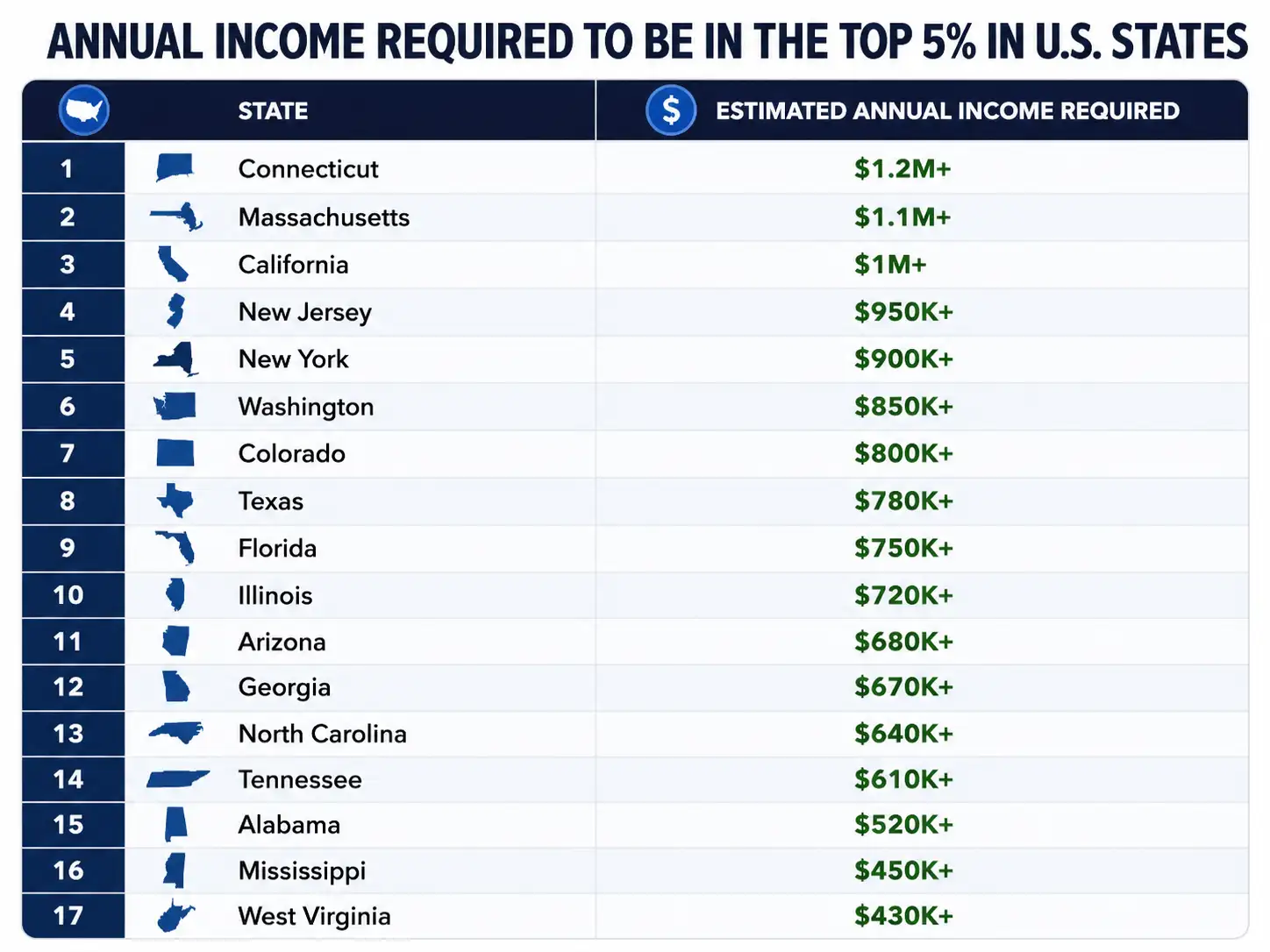
These figures are estimates and are updated periodically based on tax and income data.
Why Does the Top 1% Income Vary by State?
Several economic factors influence the income needed to reach the top 1%.
1. Cost of Living
States like California and New York have significantly higher living costs.
Luxury homes, healthcare, childcare, and taxes increase the income needed to maintain a high standard of living.
2. Local Economy
Technology, finance, healthcare, and investment industries often pay much higher salaries.
Examples include:
- Silicon Valley
- New York City
- Boston
- Seattle
These cities have a larger concentration of high-income professionals.
3. Business Ownership
Many top earners don't rely solely on salaries.
Instead, they generate income through:
- Private businesses
- Investments
- Equity ownership
- Commercial real estate
4. Taxes
State tax policies influence disposable income and earning patterns.
Some states have:
- No state income tax
- Lower corporate taxes
- Better business environments
These factors can attract wealthy individuals.
Income vs. Net Worth: They're Not the Same
One of the biggest misconceptions is assuming income equals wealth.
In reality, they're very different.
Income
Money earned every year.
Examples:
- Salary
- Business profits
- Bonuses
Net Worth
Everything you own minus everything you owe.
Examples include:
- Real estate
- Stocks
- Retirement accounts
- Businesses
- Cash
- Luxury assets
Many millionaires earn modest salaries but have enormous investment portfolios.
Common Careers Among America's Top 1%
High-income households often include professionals such as:
- Technology executives
- Entrepreneurs
- Investment bankers
- Hedge fund managers
- Corporate executives
- Medical specialists
- Successful lawyers
- Real estate investors
- Private equity professionals
- Business owners
These careers often combine high salaries with bonuses, stock options, or business equity.
How Do People Reach the Top 1%?
Most high earners follow similar long-term strategies.
Build High-Income Skills
Professionals in AI, finance, engineering, healthcare, and executive leadership often command premium salaries.
Start a Business
Business ownership offers significant income potential through profits and equity growth.
Invest Consistently
Successful individuals often invest in:
- Stock markets
- Index funds
- Commercial real estate
- Private businesses
Diversify Income
Instead of relying on one paycheck, many top earners generate multiple income streams, including investments and side businesses.
Think Long Term
Reaching the top 1% usually takes years of disciplined career growth, saving, and investing rather than overnight success.
Lifestyle of America's Top 1%
High-income households often enjoy:
- Luxury homes
- Premium travel
- Private clubs
- Fine dining
- Investment properties
- Exclusive networking events
- High-end vehicles
- Global business opportunities
However, many wealthy individuals also prioritize financial planning, philanthropy, and long-term wealth preservation over conspicuous spending.
Does Earning More Always Mean Being Wealthy?
Not necessarily.
A household earning $1 million annually can still struggle financially if expenses and debt are extremely high.
Conversely, someone earning less but investing wisely over decades may accumulate substantial wealth.
Financial independence depends on:
- Savings rate
- Investment growth
- Spending habits
- Debt management
The Psychology of High Earners
Many top-income individuals share common habits:
- Goal-oriented mindset
- Continuous learning
- Strategic networking
- Calculated risk-taking
- Time management
- Long-term planning
- Consistent investing
- Adaptability
These habits often contribute as much to financial success as income itself.
Relationships and Success
As careers advance, many professionals find it increasingly difficult to meet partners who understand their ambitions and lifestyles.
Executives, entrepreneurs, doctors, investors, and business owners often seek relationships with people who appreciate shared values, mutual respect, and compatible life goals.
While financial success can create opportunities, lasting relationships are built on trust, communication, and genuine compatibility—not income alone.
Final Thoughts
The annual income required to be in the top 1% of the USA is generally around $800,000 per household, though the exact threshold varies significantly by state.
High-cost states such as Connecticut, Massachusetts, California, and New York require substantially higher incomes, while states with lower living costs have lower entry points.
Ultimately, reaching the top 1% involves more than earning a high salary. Long-term wealth creation comes from strategic investing, business ownership, disciplined financial management, and consistent personal growth.
Whether your goal is financial independence, career success, or building meaningful relationships, understanding these benchmarks can help you create a realistic plan for the future.

Find Meaningful Connections with Successful Singles
Success is about more than financial achievements—it's also about finding someone who shares your ambitions and values.
BeautyMeetRich is a premium dating platform designed for attractive, successful, and ambitious singles looking for genuine relationships. Whether you're a professional, entrepreneur, executive, or someone who appreciates an accomplished lifestyle, BeautyMeetRich helps you connect with like-minded people in a secure and exclusive environment.
Join BeautyMeetRich today and start meeting successful singles who value meaningful connections, shared goals, and lasting relationships.
Frequently Asked Questions (FAQs)
1. What is the annual income required to be in the top 1% of the USA?
Most estimates place the threshold at approximately $780,000–$850,000 in annual household income, depending on the latest available data and location.
2. Which U.S. state requires the highest income to be in the top 1%?
States such as Connecticut, Massachusetts, and California generally have the highest income thresholds due to higher living costs and concentrations of high-paying industries.
3. Is the top 1% based on individual income or household income?
Most analyses use household income, meaning the combined earnings of everyone in a household.
4. Does being in the top 1% mean you're a millionaire?
Not necessarily. The top 1% is based on annual income, while being a millionaire usually refers to net worth exceeding $1 million.
5. Can entrepreneurs reach the top 1% faster than salaried employees?
Entrepreneurs often have greater earning potential through business profits and equity, but success depends on the performance and growth of their businesses. Salaried professionals in fields like technology, finance, and medicine can also reach top-income levels over time.